Anthropic Academy (also called Claude Academy) is Anthropic’s free learning hub for Claude. It has 27 self-paced courses in six tracks, from Claude 101 and AI Fluency for everyday users to Claude Code, the API and the Model Context Protocol for developers. Every course is free with a free account, and the 23 courses that end with a quiz give a certificate of completion.
Where to start:
- Claude 101 if you’re new;
- AI Fluency if you want a framework for working with any AI;
- the developer track only if you build with the API.
Below: every course, how long it takes, what the certificate is worth, and what to learn next.
Key terms used in this guide: AI literacy, model context protocol, and prompt engineering.
Anthropic Academy at a glance
| Cost | Free. You can open lessons without signing in; a Claude account saves your progress. A few hands-on exercises need a paid Claude plan or an API key. |
|---|---|
| Number of courses | 27, inside a catalog of 308 resources that also includes short tutorials and use-case guides |
| Tracks | Six: Claude, Claude Cowork, Claude Code, Claude Tag, Claude Platform, plus AI Fluency |
| Format | Self-paced lessons with a quiz at the end of most courses; listed lengths run from 45 minutes to 9 hours |
| Certificate | A certificate of completion, shown as a completion badge, for the 23 courses that end with a quiz. Not accredited and not a certification |
| Who it’s for | Everyday Claude users, educators and students, team leads, and developers working with Claude Code, the API and MCP |
| Last verified | October 22, 2026, on academy.claude.com and anthropic.skilljar.com |
What the Academy is, and why you’ll see two web addresses
The Academy is run by Anthropic’s education team and lives at academy.claude.com. Besides full courses, it collects short tutorials and use-case guides, which is why the “All resources” page shows 308 items while the course count is 27. All Anthropic courses in the public catalog sit here, from a first conversation with Claude to production patterns for the API.
The second address in search results, anthropic.skilljar.com, is the older home of the same program. Skilljar is the learning platform Anthropic uses to host courses and track progress. Its catalog still works, but on October 22 it listed fewer courses (Introduction to Claude Tag, for one, was missing), so treat academy.claude.com as the reference.
Every course in the catalog
The table covers all 27 Claude courses listed on October 22, 2026. Lengths and quiz status come from the official course listings. The level column is our own label, based on each course’s stated audience and prerequisites. Add up the listed durations and you get roughly 80 hours, which is a good argument for following a path rather than trying to finish everything.
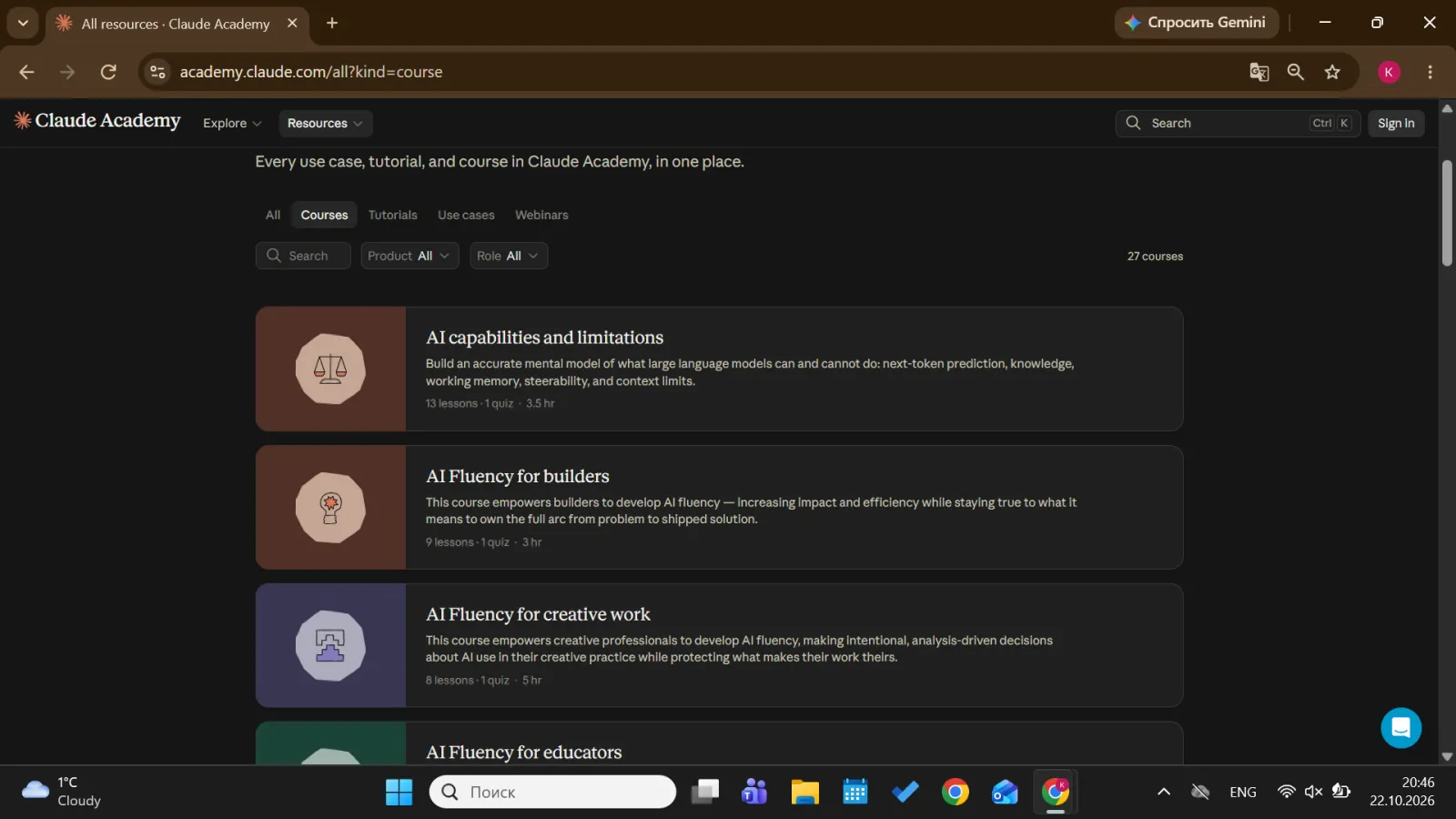
Screenshot 1. The course catalog on academy.claude.com
| ### Course | ### Track | ### Level | ### Length | ### Certificate? | ### Best for |
|---|---|---|---|---|---|
| Claude 101 | Claude | Beginner | 2.5 hr | Yes | A first structured tour of Claude for everyday work |
| Deploying Claude Enterprise with confidence | Claude | Intermediate | 2.5 hr | Yes | Admins deciding access, governance and spend |
| Introduction to Claude Cowork | Claude Cowork | Beginner | 2.5 hr | Yes | Handing multi-step file and research work to Claude |
| Introduction to Claude Tag | Claude Tag | Beginner | 2.5 hr | Yes | Teams that work with Claude inside Slack |
| Claude Code 101 | Claude Code | Intermediate | 1.5 hr | Yes | Developers new to coding agents |
| Claude Code in action | Claude Code | Intermediate | 1 hr | Yes | Longer, hands-off Claude Code sessions |
| Introduction to agent skills | Claude Code | Intermediate | 1 hr | No quiz listed | Turning repeat instructions into skills |
| Introduction to subagents | Claude Code | Intermediate | 45 min | No quiz listed | Splitting big tasks across subagents |
| The AI-native SDLC playbook | Claude Code | Advanced | 1 hr | No quiz listed | Engineering leads redesigning review and release |
| Claude Platform 101 | Claude Platform | Intermediate | 1.5 hr | Yes | First steps with the Claude API |
| Building with the Claude API | Claude Platform | Advanced | 9 hr | Yes | Prompting, tool use, RAG and agents in depth |
| Claude with Amazon Bedrock | Claude Platform | Advanced | 8 hr | Yes | Teams deploying Claude on AWS |
| Claude with Google Cloud’s Vertex AI | Claude Platform | Advanced | 8.5 hr | Yes | Teams deploying Claude on Google Cloud |
| Introduction to Model Context Protocol | Claude Platform | Intermediate | 1 hr | Yes | Building MCP servers and clients in Python |
| Model Context Protocol: Advanced topics | Claude Platform | Advanced | 1.5 hr | Yes | Production MCP: sampling, notifications, transports |
| AI Fluency: Framework and foundations | AI Fluency | Beginner | 4 hr | Yes | Anyone who wants the 4D framework |
| AI capabilities and limitations | AI Fluency | Beginner | 3.5 hr | Yes | Understanding why models fail the way they do |
| Building effective human-agent teams (beta) | AI Fluency | Intermediate | 45 min | Yes | Leads preparing a team for shared AI work |
| AI Fluency for students | AI Fluency | Beginner | 3 hr | Yes | Study, career planning and coursework |
| AI Fluency for educators | AI Fluency | Beginner | 1.5 hr | Yes | Faculty and instructional designers |
| Teaching AI Fluency | AI Fluency | Intermediate | 4.5 hr | Yes | Instructors who teach and assess AI Fluency |
| AI Fluency for pK–12 educators | AI Fluency | Beginner | 3 hr | Yes | School teachers |
| AI Fluency for pK-12 Train the Trainer | AI Fluency | Intermediate | 45 min | No quiz listed | Teachers running workshops for colleagues |
| AI Fluency for nonprofits | AI Fluency | Beginner | 4 hr | Yes | Mission-driven teams with small budgets |
| AI Fluency for small businesses | AI Fluency | Beginner | 3.5 hr | Yes | Owners and staff of small firms |
| AI Fluency for builders | AI Fluency | Intermediate | 3 hr | Yes | People who ship products end to end |
| AI Fluency for creative work | AI Fluency | Beginner | 5 hr | Yes | Creative professionals guarding their own voice |
Note: “Yes” means the course ends with a quiz and a completion badge. “No quiz listed” means the catalog shows no quiz for that course, so check the course page before counting on a badge.
The 4D framework in one paragraph
Ten of the courses are versions of AI Fluency, a framework created by professors Rick Dakan (Ringling College of Art and Design) and Joseph Feller (University College Cork) and turned into courses with Anthropic. It names four skills: Delegation (deciding whether and how to involve AI), Description (saying clearly what you want), Discernment (judging the output) and Diligence (owning what you do with it). The audience versions apply the same ideas to different jobs, so take the foundations course plus the one variant that fits yours.
On the developer side, two courses fit into a lunch break: agent skills (1 hour) and subagents (45 minutes). If skills are new to you, our explainer on Claude Skills shows what they do before you build your first one.
The Academy teaches Claude well. If your week also runs on ChatGPT and other tools, Coursiv’s 28-Day AI Certificate Program builds a daily habit across them, with short practice tasks and a CPD-accredited certificate.Start the 28-day program.
Which course to take first: learning paths by role
Find your row, take the first course, and move on once you’ve used it on a real task.
| ### Role | ### First course | ### Next course | ### What you’ll be able to do |
|---|---|---|---|
| Complete beginner | Claude 101 (2.5 hr) | AI Fluency: Framework and foundations (4 hr) | Write and refine prompts, use Projects and artifacts, and judge answers critically |
| Professional or knowledge worker | Claude 101 | Introduction to Claude Cowork (2.5 hr) | Hand Claude multi-step work on your files and review the results |
| Educator or student | AI Fluency for students (3 hr) or AI Fluency for educators (1.5 hr) | AI Fluency: Framework and foundations; instructors add Teaching AI Fluency | Apply the 4D framework to studying, course design and assessment |
| Developer | Claude Code 101 (1.5 hr), or Claude Platform 101 if you build on the API | Claude Code in action, or Building with the Claude API (9 hr) | Run the explore, plan, code, commit loop, or ship tool-using apps on the API |
| Team lead rolling Claude out | Deploying Claude Enterprise with confidence (2.5 hr) | Introduction to Claude Tag, or Building effective human-agent teams (45 min) | Make the access, governance and spend decisions behind a rollout |
Claude 101 works on any Claude plan, including Free, though a few lessons cover paid features. Claude Code 101 needs a Pro, Max or Enterprise plan, or an API key, for the hands-on parts. If you want to practise in the chat window while you take Claude 101, keep our beginner’s guide to using Claude open in another tab. Students who want more than the two student-focused options here can compare them with other free AI courses with a certificate for students. Developers who learn by doing can start with our hands-on guide to Claude Code for beginners and return to the course for the theory.
Does the Academy give a certificate?
Yes, for most courses. Pass the final quiz and you get a record of completion, which Anthropic’s certification pages call a certificate of completion you can share. On academy.claude.com the same item appears as a “Completion badge” and the quiz page’s own web address ends in certificate-of-completion. So the Anthropic Academy certificate is one thing with two names: proof that you finished a specific course and passed its quiz.
Four courses show no quiz in the catalog: Introduction to agent skills, Introduction to subagents, The AI-native SDLC playbook and AI Fluency for pK-12 Train the Trainer. Check those pages before you plan around a badge.
Also, sharing is simple. Each badge sits on your Academy learning page with a public link anyone can open, and the badge page has an Add to LinkedIn button.
What is it worth to an employer? Anthropic doesn’t describe these certificates as accredited, and they aren’t a Claude certification. The quiz isn’t proctored and anyone can take it, so a hiring manager will read the badge as a sign that you took Claude seriously, not as proof that you can deliver. It works best next to something you built, like a team prompt library or a small app on the API. For more on how employers see this kind of credential, read whether app-based AI certificates are credible.
If you need something with more formal weight, our ranking of the best AI certifications compares exam-based options.
Our review of 3 courses
We took one course from each main path.
Claude 101: the right first course
Listed at 13 lessons, one quiz and 2.5 hours. It runs from your first conversation through Projects, artifacts and skills to connectors and Research, then ends with use cases by role and a quick tour of other Claude products.
What’s good: one pass covers the whole product, and the lesson on the three ways of working in the desktop app (chat, Cowork and Code) makes it easier to pick the right mode.
What’s missing: on the Free plan you’ll read about some features you can’t try, and it’s a tour more than a workout. What a deeper course should add on top is covered in our guide to choosing a Claude AI course.
AI Fluency: Framework and foundations: the one that ages best
Listed at 14 lessons, one quiz and 4 hours. It teaches the 4D framework, how large language models work, and the Description-Discernment loop of asking, checking and refining.
What’s good: almost nothing depends on a specific product, so it stays useful when interfaces change. It even discloses how its authors used Claude to build it, a neat example of Diligence.
What’s missing: it’s more reflective than practical, so apply each D to a real task between lessons.
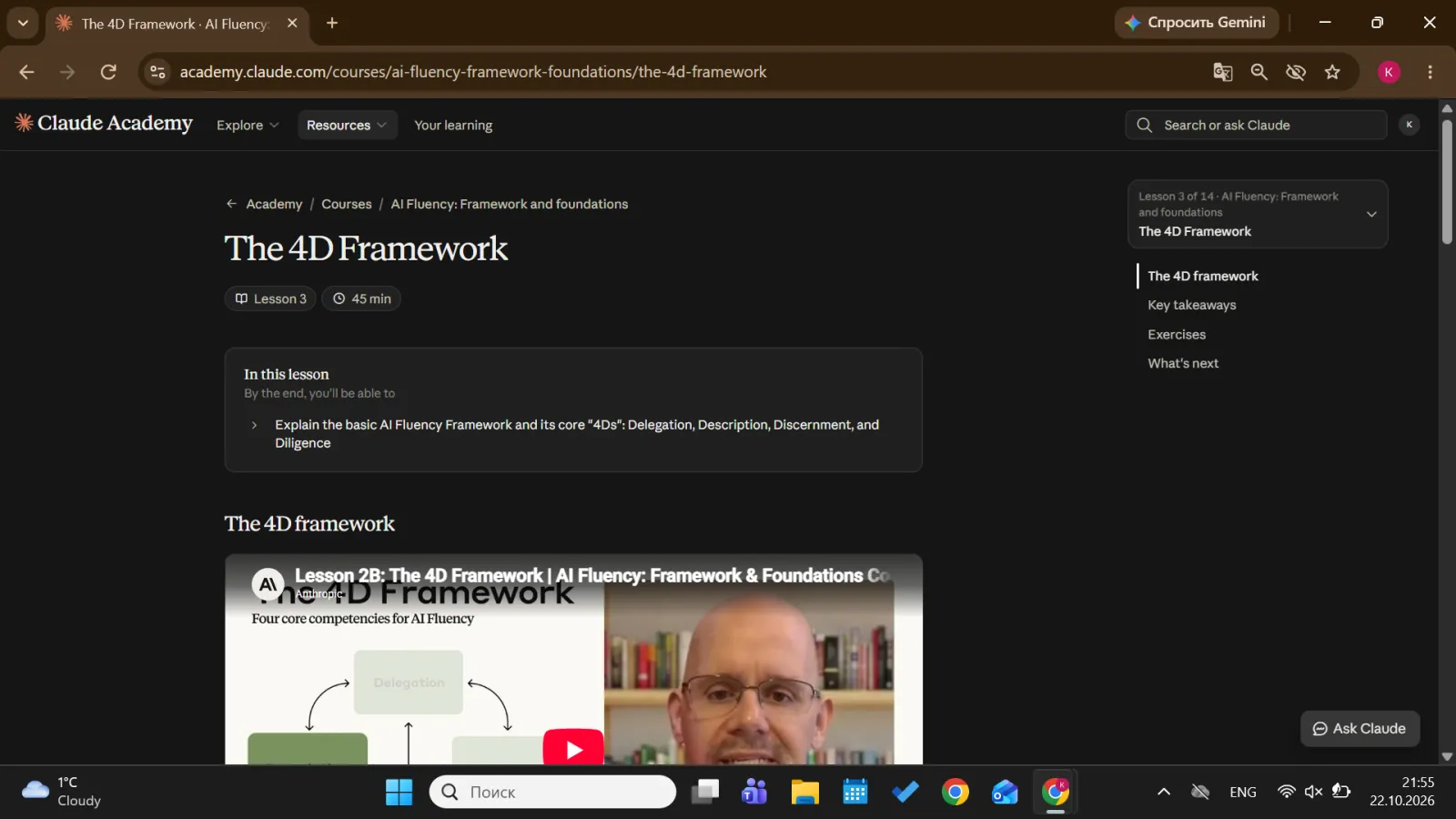
Screenshot 2. The 4D Framework lesson in AI Fluency: Framework and foundations
Claude Code 101: practical, but bring a paid plan
Listed at 12 lessons, one quiz and 1.5 hours. It starts with how a coding agent works, then covers installation, the explore → plan → code → commit workflow, context commands like /compact, and customization through CLAUDE.md, subagents, skills, MCP and hooks.
What’s good: it explains why techniques work before showing them, and reaches customization topics many intros skip.
What’s missing: the hands-on parts need a Pro, Max or Enterprise plan or an API key, and that’s a lot of ground for 1.5 hours.
For what a fuller course should add, see our guide to picking a Claude Code course.
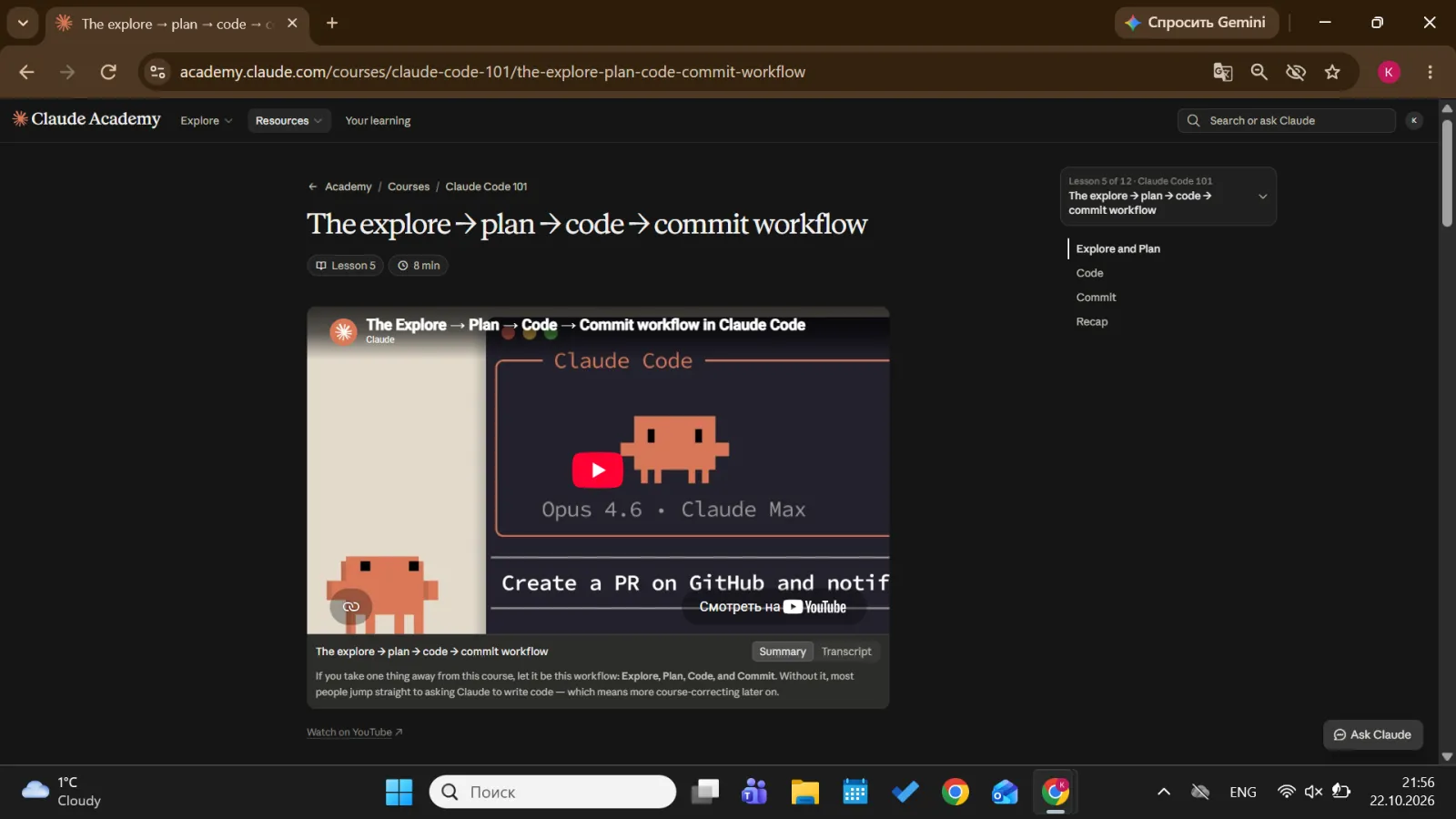
Screenshot 3. The explore → plan → code → commit lesson in Claude Code 101
How to sign up and finish a course
Anthropic Academy courses are self-paced, so you can stop between lessons and pick up where you left off.
- Pick a course on academy.claude.com. Each course page lists lessons, length, quiz and prerequisites.
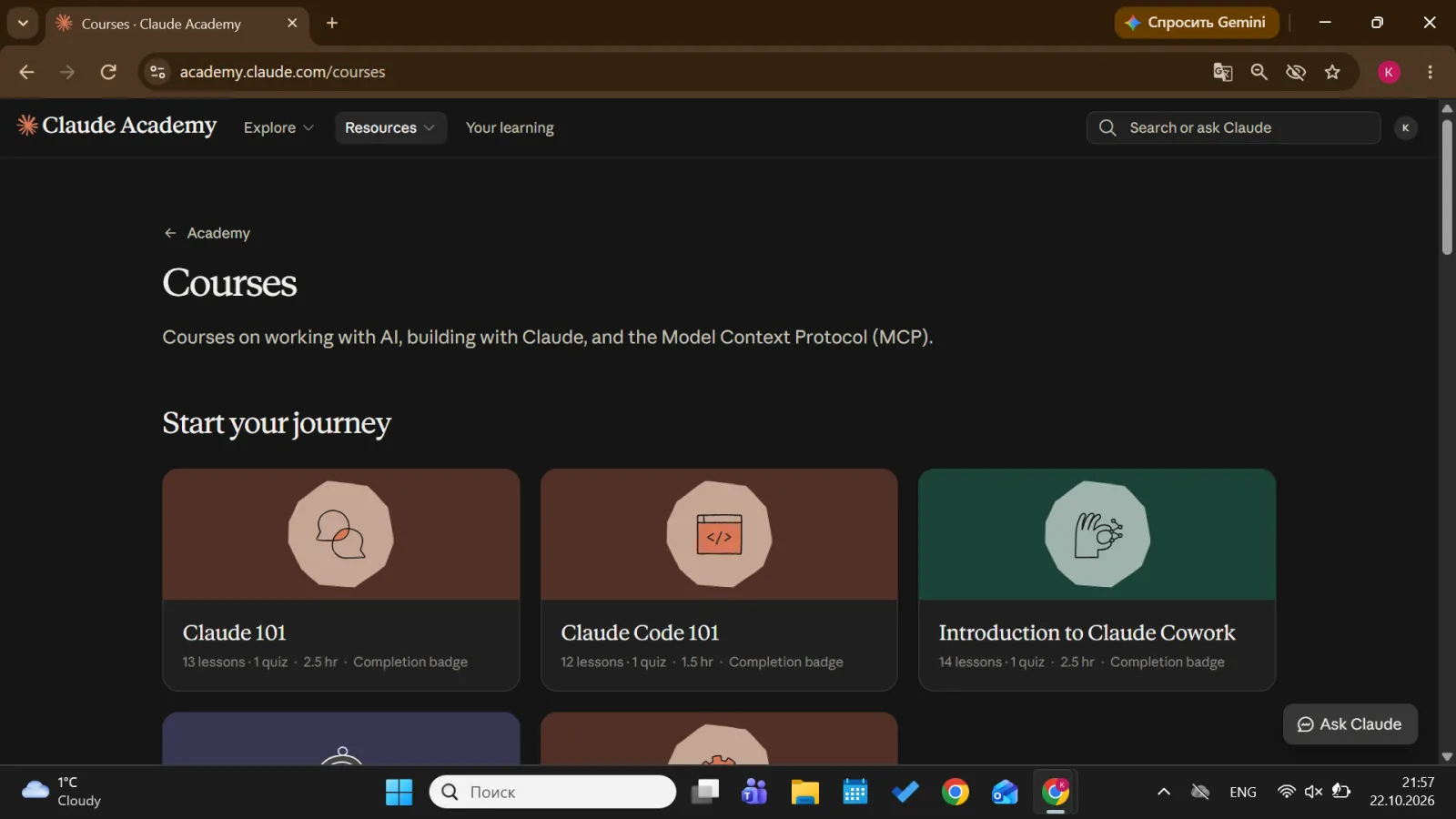
Screenshot 4. The Courses page
- Sign in to save progress. Click “Sign in to save progress” on the course page. You can read lessons without an account, but progress is saved to one.
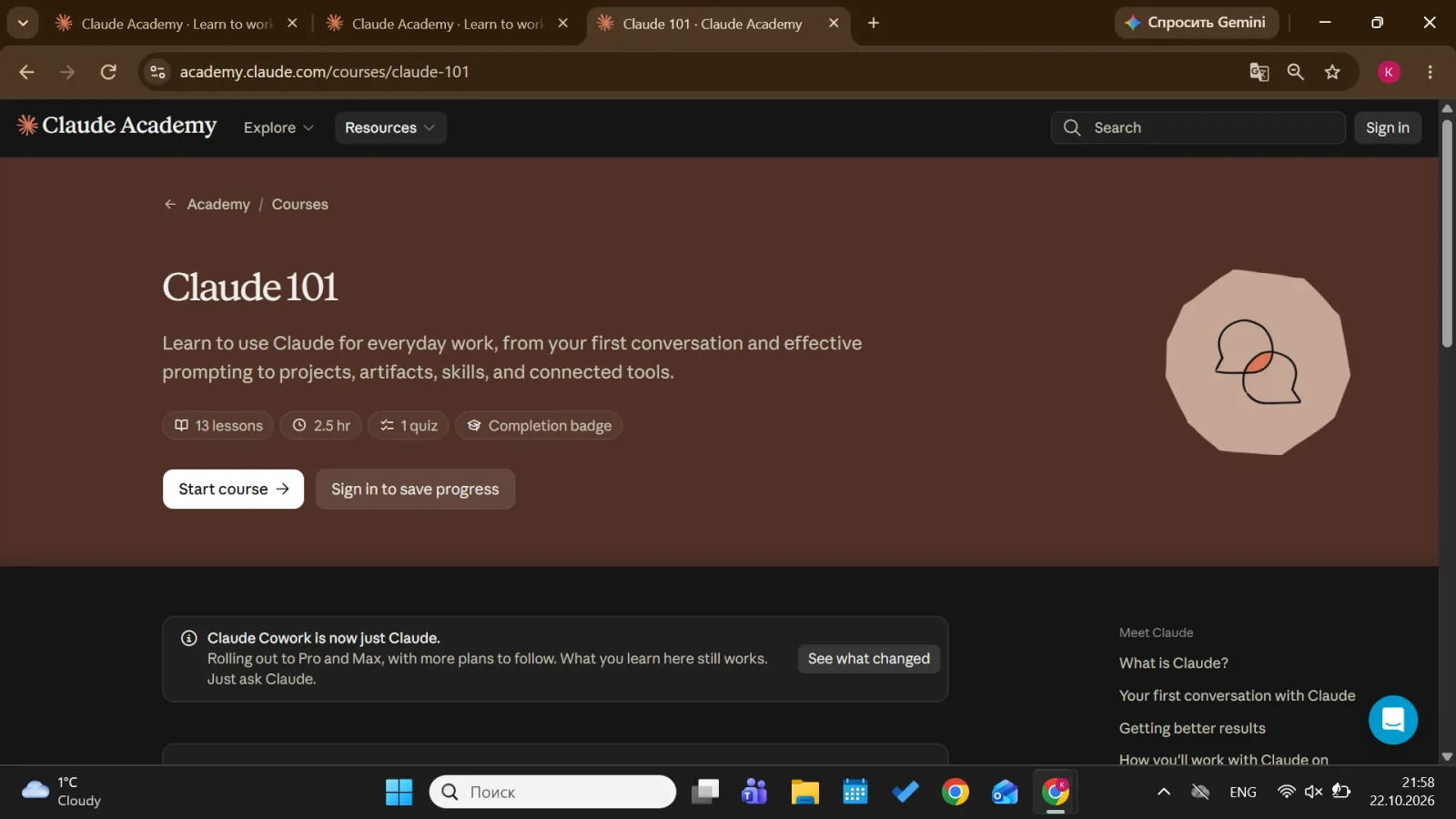
Screenshot 5. The Claude 101 course page with the sign-in option
Work through the lessons in order. The quiz draws on the whole course.
Take the course quiz. It’s the last item; passing it unlocks the badge.
Open your badge. The badge page shows the course name, your name and the date.
Share it. Copy the public link for your CV or portfolio, or use Add to LinkedIn.
How the Academy compares with other free AI courses
If Claude is your main tool, Anthropic’s catalog is the deepest free option. The alternatives differ in tools covered and certificate type.
| Anthropic’s Academy | OpenAI Academy | Google Prompting Essentials | Coursiv AI Certificate Program | |
|---|---|---|---|---|
| Cost | Free | Free; needs a ChatGPT account | Paid through Coursera (check the current price; financial aid is offered) | Paid subscription (see current pricing) |
| Format | 27 self-paced courses, most ending in a quiz | Self-paced courses | One self-paced course, 4 modules, fully online | 28-day program of short daily lessons and practice tasks |
| Tools covered | Claude, Cowork, Claude Code, Claude Tag, the API and MCP, plus tool-agnostic AI Fluency | OpenAI products, mainly ChatGPT | Prompting with generative AI tools, built on a five-step method | ChatGPT, Claude and other AI tools |
| Certificate type | Certificate of completion (shown as a completion badge); not accredited, not a certification | Badges and certificates of completion; OpenAI says they are not OpenAI Certifications | Certificate from Google | CPD-accredited certificate (AI Mastery Certificate Program) |
| Time | 45 min to 9 hr per course | Varies by course | Under 10 hours | 28 days |
Prompting carries across all four; our guide on how to learn prompt engineering has a plan that works with any of them.
After the Academy
The Claude Certified Architect exam
Claude Certified Architect – Foundations is a proctored exam delivered by Pearson VUE, online or at a test center, and it tests Claude Code, the Claude Agent SDK, the Claude API and MCP. Anthropic lists it at $125 (the Professional level costs $175), scores it from 100 to 1,000 with 720 needed to pass, and the credential stays valid for 12 months. Only people who work at organizations in the Claude Partner Network can register. [Add the Claude Certified Architect article ]
When a structured, multi-tool program makes sense
The Academy is the best free place to learn Claude, and we’d send most readers there first. By design, it teaches one company’s tools and leaves practice up to you. If your week mixes ChatGPT, Claude and other assistants, the gap is less about features and more about a routine that keeps AI in your real work.
That’s where Coursiv fits. Its AI Mastery Certificate Program is CPD-accredited and runs as short daily lessons with practice tasks across ChatGPT, Claude and other tools, with 700k+ certificates issued so far. It doesn’t promise a job or a raise, and it doesn’t replace the Academy’s developer courses. Learn more about ourAI Certificate Program.
If you’re planning a broader route, our guide on how to learn AI in 2026 shows where each piece fits.
Start with one course this week
Open Claude 101, block out an evening, and finish it. If you’d also like a daily routine across ChatGPT, Claude and other tools, with practice tasks and a CPD-accredited certificate, Coursiv’s 28-day program is built for that, with more than 3M subscriptions purchased. Start the 28-day AI Certificate Program.